
Oct 14, 2026 ·
Living with a cat can feel like sharing your home with a very small, very mysterious roommate. One minute she is pressing her paws into your stomach like she is making bread. The next, she is staring at you from across the room without blinking, or chirping at the window as if telling a secret to the birds.
It is no surprise that “why does my cat…” is one of the most searched questions among cat owners. The good news is that almost every one of these habits has a simple, sensible explanation rooted in instinct, communication, or affection.
In this guide, we will decode ten of the most common cat behaviors: kneading, chirping, staring, slow blinking, head-butting, purring, zoomies, bringing gifts, knocking things off tables, and showing the belly. For each one, you will learn what it usually means, how to respond, and when it might be worth a call to your vet.
A quick note before we begin: no two cats are exactly alike. Use this guide as a friendly starting point, and let your own cat’s personality fill in the details.
1. Kneading: Making Biscuits
Kneading is when your cat rhythmically pushes her front paws in and out against a soft surface, such as a blanket, a pillow, or your lap. Many owners call it “making biscuits”.
What it usually means
The habit starts in kittenhood. Nursing kittens knead around their mother to help milk flow, and the motion becomes linked with comfort and safety. Adult cats often carry it into later life as a way of saying they feel relaxed and content. Kneading may also help them make a soft spot to rest, and the scent glands in their paws can leave a faint personal mark on the spot.
How to respond
Enjoy it, if your cat’s claws are not bothering you. Keep her nails trimmed, and place a thick blanket on your lap as a buffer. Do not punish her for kneading, since it is an instinctive comfort habit. If it becomes uncomfortable, gently move her to a soft blanket instead.
When to check in
Kneading is normal. If it suddenly becomes frantic, or comes with other changes in behavior, mention it to your vet.
2. Chirping and Trilling: Cat Conversation
A chirp is a short, bird-like sound, while a trill is a rolling, upward “brrrp”. You may hear both when you walk into a room, or when your cat sees something interesting.
What it usually means
Trilling is a friendly greeting. Mother cats use similar sounds to call their kittens, and adult cats often use them to say hello to people they trust. It can also mean “follow me”, especially if she heads toward her food bowl. Chirping and chattering at birds or squirrels outside the window is usually a sign of excitement, and perhaps a little frustration at being unable to reach her “prey”.
How to respond
Talk back! Cats often enjoy a soft, friendly voice, and a quiet reply can strengthen your bond. If she trills and leads you to the kitchen, check whether her bowl or water needs a refill.
When to check in
These sounds are normal and happy. But a sudden increase in loud or distressed vocalizing, especially at night or in an older cat, can signal pain, confusion, or an overactive thyroid. In that case, book a vet visit.
3. Staring: The Unblinking Gaze
If your cat has ever sat across the room watching you with wide eyes, you have wondered what she is thinking.
What it usually means
The meaning depends on the rest of her body language.
- Relaxed stare: soft eyes, relaxed body, maybe a slow blink. She is simply watching you, or waiting for attention, food, or play.
- Curious stare: ears forward and body still. She is trying to work out what you are doing.
- Tense stare: wide eyes, flattened ears, stiff body, or a twitching tail. A hard, fixed stare can be a challenge or a warning, especially between cats.
How to respond
If she looks relaxed, a gentle word or a slow blink back is a lovely reply. If she looks tense, avoid staring directly at her, since in cat language that can seem threatening. Look away, give her space, and let her calm down.
When to check in
A cat who stares at walls for long periods, seems confused, or appears disoriented may need a vet check, particularly if she is older.
4. Slow Blinking: The Cat Kiss
When your cat looks at you and slowly closes and opens her eyes, she is doing something many owners call a “cat kiss”.
What it usually means
Slow blinking is widely seen as a sign of trust and relaxation. In the wild, closing your eyes near another animal makes you vulnerable, so doing it around you suggests she feels safe. There is even research suggesting that cats respond more warmly to people who slow blink at them, which supports the idea that it works as a friendly signal.
How to respond
Blink back. Look softly at her, close your eyes slowly for a moment, and open them again. Many cats will answer with another slow blink, and some will walk over for a cuddle. It is a lovely way to build trust with a shy or newly adopted cat, who may feel less pressured than with petting or direct eye contact.
When to check in
Slow blinking is a good sign. If your cat is squinting or half-closing one or both eyes along with redness or discharge, that is something different, and a sign of eye discomfort that needs a vet.
5. Head-Butting and Rubbing: A Scent Handshake
Your cat bumps her forehead against your hand, rubs her cheek on your leg, or winds around your ankles as you walk.
What it usually means
Cats have scent glands on their cheeks, forehead, chin, and the base of the tail. When she rubs against you, she is leaving her scent, which marks you as part of her family and territory. It is also a friendly greeting. Cats often do the same with each other, and with favorite furniture, doorways, and corners. You may notice she rubs more after you come home, since she is blending the smells you picked up outside with her own.
How to respond
Accept the greeting. Offer a finger for her to nuzzle, or scratch gently under the chin or around the cheeks, where many cats love to be touched. Because she is leaving her own scent, it helps keep her calm and comfortable, so there is no need to wipe it away.
When to check in
This is a healthy, affectionate behavior. A cat who suddenly presses her head against a wall or corner and seems unable to move away is a different matter. That “head pressing” can signal a serious neurological problem and needs urgent veterinary attention.
6. Purring: More Than Just Happiness
Purring is one of the most recognizable cat sounds, and also one of the most misunderstood.
What it usually means
Most of the time, a purring cat is relaxed and content, curled on your lap or soaking up the sun. Kittens begin purring within days of birth, as a way to signal to their mother that they are okay.
But cats also purr in other situations. Some purr when they are anxious, frightened, in pain, or even unwell, possibly as a way of calming themselves. Some cats purr to ask for food or attention. The only way to read a purr correctly is to look at the whole cat.
Reading the context
- Soft body, half-closed eyes, kneading: contentment.
- Purring near the food bowl: a request for a meal.
- Purring with hunched posture, hiding, flattened ears, or reluctance to move: possible stress or pain.
How to respond
Enjoy the happy purrs, and respond to the request ones. If your cat purrs but seems uncomfortable, check for other signs of illness and call your vet if you are worried.
A myth to skip
You may have heard that purring heals cats. The idea is popular, but it is not proven, and a purring cat can still be seriously ill. Never treat purring as proof that all is well.
7. Zoomies: The Midnight Sprint
Out of nowhere, your cat shoots across the room, bounces off the sofa, and tears down the hall as if chased by something invisible. Vets and owners call these bursts “zoomies”.
What it usually means
Zoomies are a way to release pent-up energy. Cats are natural hunters who sleep most of the day, so energy builds up and needs somewhere to go. You will often see them in the evening or early morning, when cats are naturally most active, after using the litter box, or after a meal. Kittens and young cats have them most, but adults get them too.
How to respond
Make sure the path is clear and fragile items are out of the way. Then give her better outlets:
- Play with a wand toy for 10 to 15 minutes, once or twice a day, especially in the evening.
- Finish play with a small meal, to mimic a hunt, catch, and eat cycle.
- Add climbing spaces, puzzle feeders, and window perches.
Avoid chasing her or using your hands as toys, which can teach rough play.
When to check in
Zoomies are healthy. But if your cat seems frantic, is panicking, or is vocalizing loudly while running, rule out causes such as pain, skin problems, or an overactive thyroid with your vet.
8. Bringing Gifts: A Hunter’s Offering
Your cat drops a toy mouse at your feet, carries a sock into the living room while yowling, or, if she goes outdoors, delivers something far less welcome.
What it usually means
This is natural hunting behavior. There are a few likely explanations. She may be sharing food with her family, as mother cats do with kittens. She may think you need to be taught to hunt, or she may simply want to show off her catch in a safe place. Many owners see it as a compliment, because it suggests she considers you part of her group.
The yowling that often accompanies a carried toy is typically a “look what I found” call.
How to respond
Stay calm and avoid scolding, since she is acting on instinct and will not understand punishment. Praise her quietly, and then dispose of any real prey safely, wearing gloves and washing your hands afterward. If you would rather prevent hunting, keep her indoors or use a secure outdoor enclosure. A bell collar or a brightly colored collar may reduce successful catches, but supervised indoor play with wand toys is the best way to satisfy her hunting drive.
When to check in
Call your vet if she brings home wildlife that could carry disease, or eats prey and then becomes unwell.
9. Knocking Things Off Tables: The Gravity Experiment
Your cat looks you in the eye, extends one paw toward a glass of water, and slowly nudges it off the edge. It is one of the most famous, and frustrating, cat habits.
What it usually means
There are a few explanations, and more than one may apply.
- Curiosity. Cats explore the world with their paws. Tapping an object tells her how it moves, sounds, and feels.
- Hunting instinct. Small, movable objects trigger the urge to bat and chase.
- Attention. If dropping something makes you react, she learns that it works.
- Boredom. A cat with few outlets will invent her own entertainment.
How to respond
The key is not to reward it. Reacting loudly, even to scold, can still count as attention. Instead:
- Keep fragile items away from edges and put valuables out of reach.
- Offer interactive play and rotating toys.
- Give her items she is allowed to knock about, such as lightweight balls.
- Reward calm behavior with treats and attention before she starts the game.
When to check in
This behavior is almost always playful. If it suddenly appears with clumsiness, bumping into furniture, or poor coordination, mention it to your vet, since balance or vision problems can sometimes be the cause.
10. Showing the Belly: Trust, Not Always an Invitation
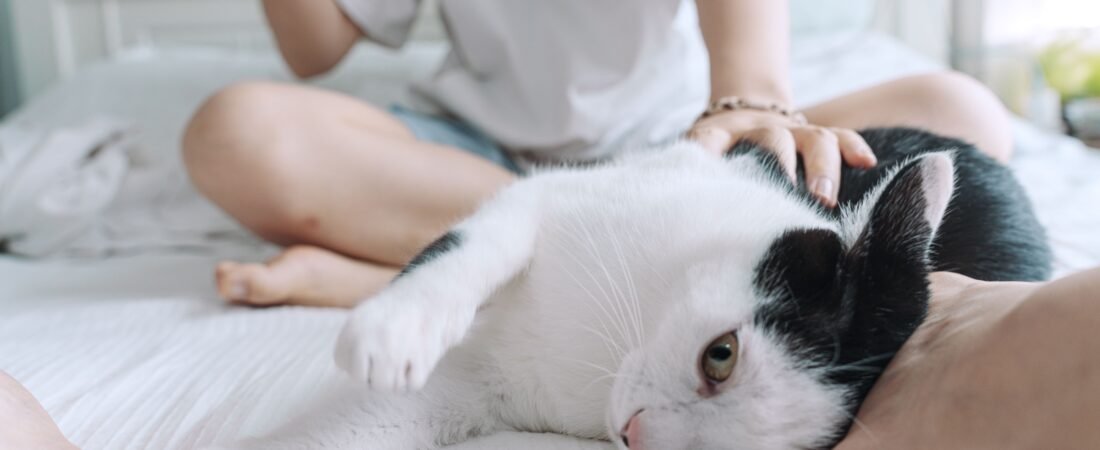
Your cat flops onto her back, belly fully exposed, and looks at you with sleepy eyes. It is tempting to dive in for a rub, but be careful.
What it usually means
The belly is the most vulnerable part of a cat’s body, so showing it generally means she feels safe and relaxed around you. It can also be a way of stretching, cooling off, or getting attention. But for many cats, it is a sign of trust, not an invitation to touch. Some cats do love belly rubs, but plenty react with claws and teeth, a reflex that protects that vulnerable area.
How to respond
- Respect the signal. Admire the trust without assuming you can pet.
- Test gently. If you want to try, offer a light touch, and stop at once if her tail flicks, ears flatten, or she grabs your hand.
- Choose safer spots. Cheeks, chin, and the base of the ears are usually more welcome.
Reading the difference
A relaxed belly display comes with soft eyes, a loose body, and maybe a slow blink. A defensive display, with wide eyes, tense muscles, or flattened ears, means she wants space and is ready to protect herself.
When to check in
If your cat suddenly objects to being touched on the belly, or flinches when you touch it, pain or discomfort could be the cause. Mention it to your vet.
Quick Reference: 10 Cat Behaviors at a Glance
| Behavior | Usually means | What to do |
|---|---|---|
| Kneading | Comfort and contentment | Trim nails, add a blanket |
| Chirping and trilling | Greeting, excitement, “follow me” | Talk back, check her bowl |
| Staring | Curiosity, attention-seeking, or tension | Read her body language |
| Slow blinking | Trust and affection | Blink back slowly |
| Head-butting | Scent marking and friendliness | Accept the greeting |
| Purring | Contentment, but sometimes stress or pain | Check the whole picture |
| Zoomies | Pent-up energy | Schedule play, clear the path |
| Bringing gifts | Hunting instinct and sharing | Stay calm, offer play |
| Knocking things off tables | Curiosity, boredom, attention | Give outlets, do not react |
| Showing the belly | Trust, not always an invitation | Respect her limits |
When a Behavior Change Means a Vet Visit
Every behavior above is normal in a healthy cat. What matters most is change. Cats hide discomfort well, so a shift in habits is often the earliest clue that something is wrong.
Contact your vet if you notice any of these:
- A sudden change in behavior, such as hiding, aggression, or withdrawal
- Loud vocalizing at night, or confusion, especially in an older cat
- Frantic or extreme versions of normal behaviors, like non-stop kneading or constant running
- Changes in appetite, thirst, or litter box habits
- Over-grooming, bald patches, or sore skin
- Limping, stiffness, or reluctance to jump
- Pressing her head against a wall, circling, or stumbling
- Breathing that looks labored or open-mouthed (an emergency)
You know your cat’s normal better than anyone. If something seems off, or just feels wrong to you, a quick call to your vet is always worthwhile.
Final Thoughts
Cats may be mysterious, but they are communicating all the time, through paws, voices, eyes, and posture. Once you understand what kneading, chirping, staring, and the rest are really saying, daily life with your cat becomes richer and more rewarding.
The best way to learn her language is to watch the whole picture: her body, the situation, and what is normal for her. Respond with patience and kindness, give her outlets for her instincts, and enjoy the small moments, like a slow blink across the room.
If you found this guide helpful, share it with a fellow cat lover. Chances are they have a puzzling cat of their own.